
If you’re planning a Bulgaria trip now, monasteries are one of the easiest ways to see the country’s history, art, and landscapes in one stop—whether you want UNESCO-listed icons like Rila, atmospheric rock-hewn sites near Ruse, or small working monasteries close to Sofia for a half-day escape.
As a Balkan-based travel writer who’s spent years exploring monastic routes across the region, I’ve found Bulgaria’s monasteries especially rewarding because many are still active religious communities while also welcoming visitors with museums, frescoes, and courtyards that are genuinely memorable.
Below is a practical, traveler-focused list—organized by type and location—so you can choose the monasteries that fit your route, your interests (icons, murals, mountains, rock caves), and the amount of driving you actually want to do.
Rock Monasteries
- Aladzha Monastery
- Basarbovo Monastery
- Ivanovo Monastery
Historical And Architectural Gems
- Bachkovo Monastery
- Rila Monastery
- Troyan Monastery
Monasteries With Natural Beauty
- Dragalevtsi Monastery
- Rozhen Monastery
- Klisura Monastery
Revival Period Monasteries
- Dryanovo Monastery
- Sokolski Monastery
- Etropole Monastery
Lesser-Known
- Cherepish Monastery
- Lozen Monastery
- Lopushna Monastery
- Obradovski Monastery
- Patriarchal Monastery of the Holy Trinity
- Razboishte Monastery
- Seven Altars Monastery
- Shipka Monastery
- Transfiguration Monastery
- Zemen Monastery
- Arapovski Monastery
- Kapinovo Monastery
- Kremikovtsi Monastery
Skip Ahead To My Advice Here!
Best Monasteries In Bulgaria For First-Time Visitors
| Monastery / Site | Closest Major Base | Why It’s Notable | UNESCO | Type |
|---|---|---|---|---|
| Rila Monastery | Sofia | Largest and most famous in Bulgaria; major murals, museum, mountain setting | Yes (1983) | Fortress-style complex |
| Bachkovo Monastery | Plovdiv | Major monastery with Byzantine/Georgian/Bulgarian cultural layers; famous icon tradition | No | Large active monastery |
| Troyan Monastery | Lovech / Troyan | Third largest; National Revival-era rebuilding; notable icon tradition | No | Large monastery complex |
| Rock-hewn Churches of Ivanovo | Ruse | Rock-cut churches with 13th–14th century frescoes | Yes (1979) | Rock-hewn monastic complex |
| Basarbovo Monastery | Ruse | Active cave monastery; the earliest written mention is commonly dated to 1431 | No | Rock/cave monastery |
| Dragalevtsi Monastery | Sofia | Historic monastery on Vitosha, founded mid-14th century | No | Easy city escape |
| Seven Altars Monastery (Osenovlashki) | Sofia | Church with seven altars; popular day-trip monastery | No | Mountain monastery |
Religious and spiritual life are central to Bulgarian life, and Christianity played a decisive role in shaping the country. When the nation endured years of foreign domination, religion was the glue that kept its culture and language alive.
The Bulgarian Orthodox Church exerted a crucial influence on preserving local culture during Ottoman rule and the postwar communist regimes.
During this period, religious life was regulated under the communist-era Denominations Act of 1949 (replaced by the Confessions Act 2002, effective 1 January 2003), and the state controlled much religious property; consequently, some monasteries and churches functioned as museums during the communist era.
However, Christianity always played an essential role in forming the Bulgarian nation and its identity. It helped to keep the native language alive during Ottoman domination and, in many respects, the national culture and traditions.
Over 200 monasteries are spread throughout the country, which certainly highlights the importance of Christianity in the nation. This is precisely why no visit to Bulgaria can be deemed complete if you do not visit at least some of the most important monasteries.
This article will introduce you to some of Bulgaria’s most remarkable and beautiful monasteries, all worth a visit during your trip.
Top 3 Must-See Monasteries In Bulgaria
The first three monasteries we present in this article are considered the country’s largest and most important: Rila, Bachkovo, and Troyan, all under the direct jurisdiction of the Holy Synod. Here are all the details you need to visit monasteries in Bulgaria.
Rila Monastery
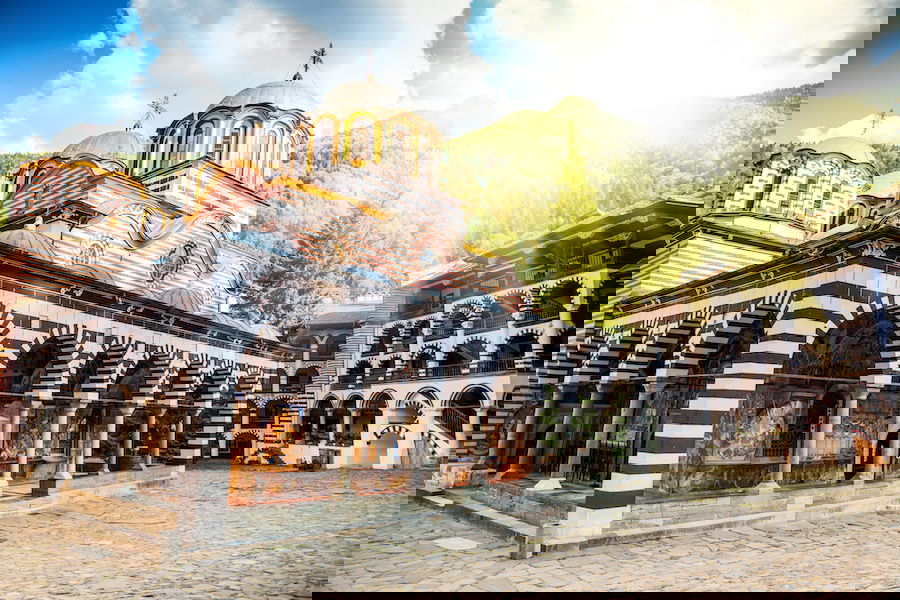
Located in the heart of the Rila Mountains, about 117 km from Sofia, Bulgaria’s capital, and at an elevation of about 1,147 meters above sea level, this is the country’s most famous and important monastery and one of the largest monastery complexes in the Balkans.
The complex dates back to the tenth century and holds the record as the largest Eastern Orthodox Monastery in Bulgaria.
Rila Monastery was founded by the hermit Saint Ivan of Rila and was included in the UNESCO World Heritage List in 1983.
Once behind the entrance gates, the colorful buildings will definitely call your attention. This is a fortress-like monastery surrounded by imposing stone walls, covering an approximate area of 8800 square meters. The monastery’s main church, dedicated to the Nativity of the Holy Virgin, features impressive murals and icons by renowned icon painters.
Inside the monastery is a library that shelters important manuscripts created between the eleventh and nineteenth centuries, as well as ancient books. Visitors can also spend time at the Ecclesiastical and Historical Museum, where collections of icons, woodcarvings, and other religious objects are displayed.
Rila Monastery Highlights You Should Not Miss
When visiting the museum, do not miss Rafail’s Cross, a wooden crucifix bearing over 100 carved Bible scenes and more than 600 miniature figures crafted with a magnifying glass. Not far from Rila Monastery, you can wander and see some small waterfalls and a wonderful walking area.
How To Get To Rila Monastery From Sofia
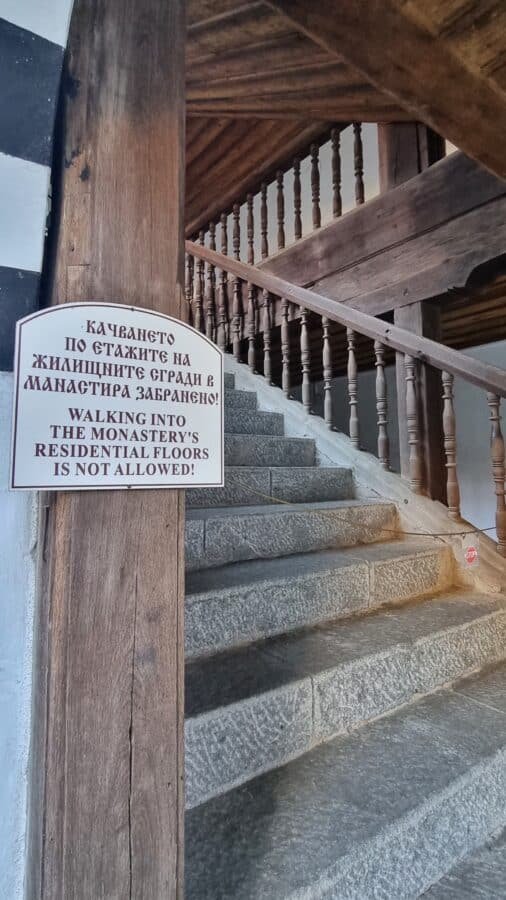
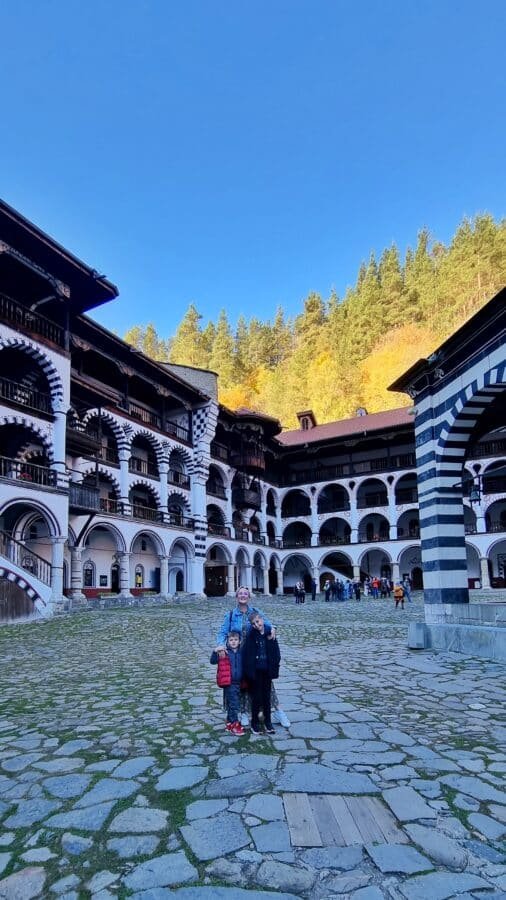
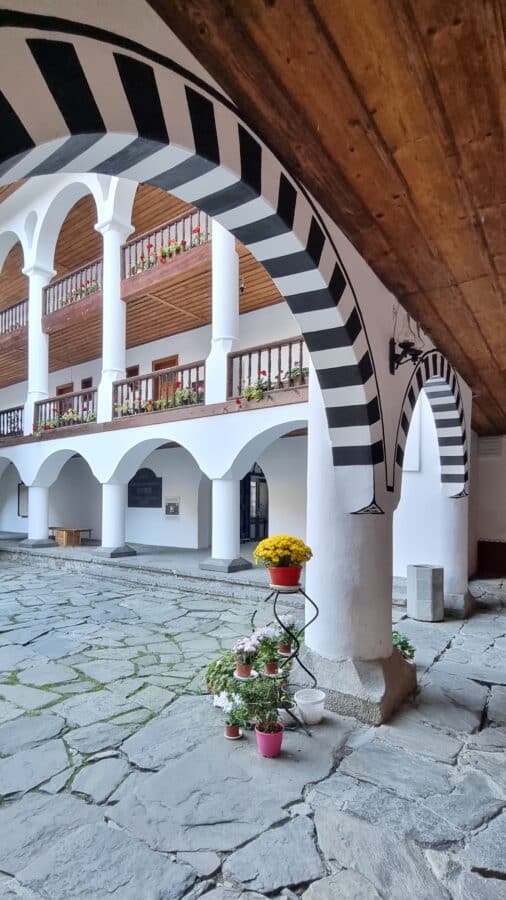
You can either visit on an organized day tour or drive from Sofia (Sofia-Kulata International Road – E79). There are also regular buses departing from Sofia, Blagoevgrad, and Dupnitsa to the area.
Driving To Rila Monastery
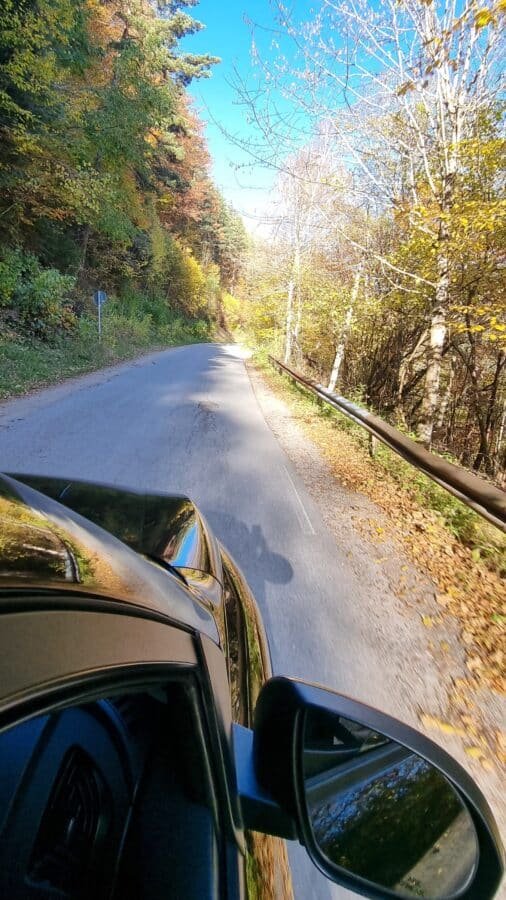
We drove from Sofia to Rila Monastery; the drive was effortless and very scenic. I totally recommend it as the ideal day trip from Sofia. Be sure to stop in the village of Pastra for lunch. Renowned for trout and many traditional Bulgarian cuisine options.
Where To Stay Near Rila Monastery Overnight
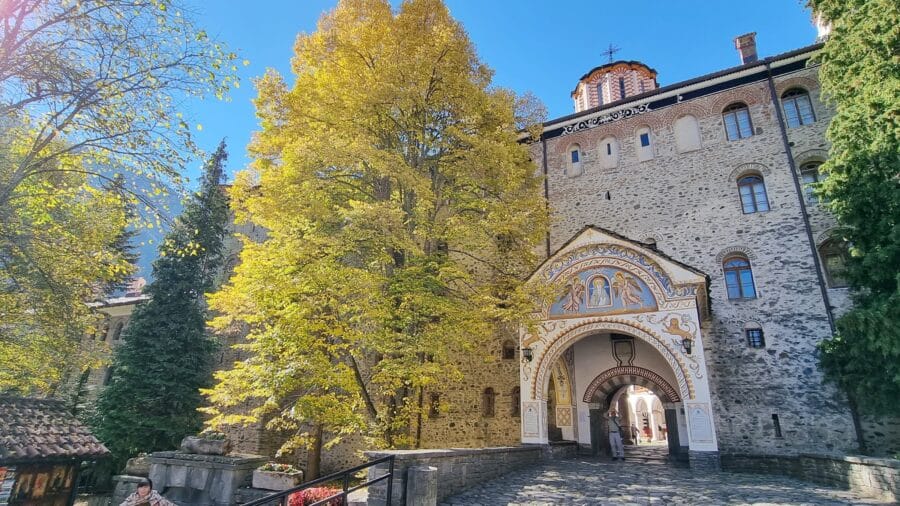
Since the monastery is quite far away from Sofia, it is good to make this a day trip and even book a stay in the area to spend the night.
If you follow the correct procedure, you can sleep in the monastery if you book well in advance! In fact, there are dormitories and private rooms. You can find all the necessary information about spending the night at Rila Monastery at this link.
Alternatively, you can book a stay at Family Hotel Gorski Kut in the Rila Valley, just 7 minutes by car from the monastery, offering comfortable, affordable accommodation with beautiful views of the river and the mountains. There’s also an onsite restaurant serving typical Bulgarian dishes.
If you want more luxury, we suggest Rilets Resort & Spa. This hotel is just 600 meters from Rila Monastery and has an onsite restaurant and bar. The hotel has a children’s play area and free private parking.
Bachkovo Monastery
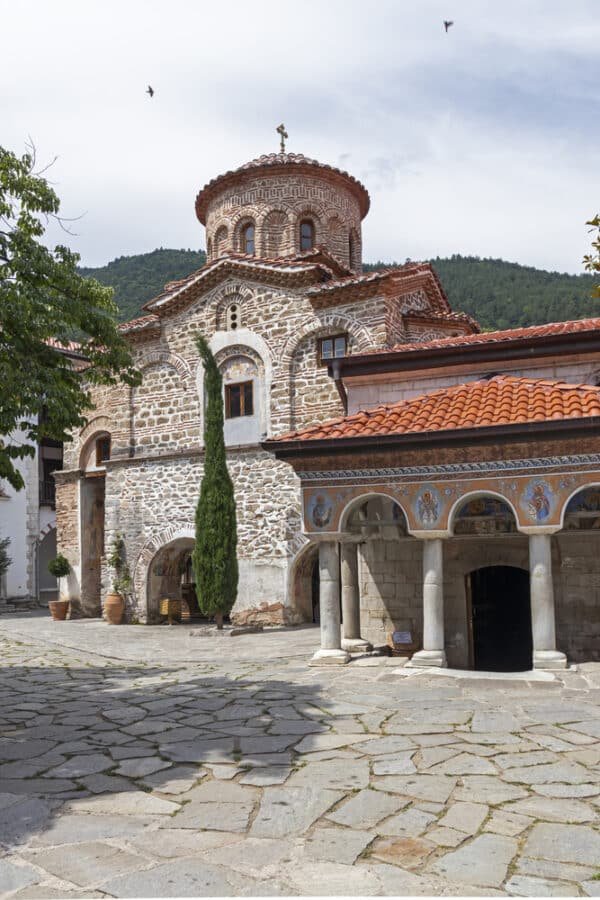
Another important monastery, the second-largest in Bulgaria after Rila, is Bachkovo Monastery, dating back to 1083. It stands about 30 km south of Plovdiv, in the village of Bachkovo in the Chaya River Valley. It is in a stunningly beautiful location, surrounded by dense forest at the foot of the Rhodope Mountains.
The complex combines elements from three distinct religious cultures: Byzantine, Georgian, and Bulgarian. Inside the monastery are three churches and the funerary church or ossuary; the oldest one dates back to the 12th century.
Bachkovo was considered a great religious and epistolary center, while its unique library treasures old Georgian, Byzantine, and Bulgarian books.
The main church, dedicated to the Virgin Mary, was built in 1604 and preserves one of the oldest wood-carved icons in the country. The church also features remarkable murals in its narthex and on the western walls. Every August 15, thousands attend a special mass dedicated to the Virgin within the monastery’s walls.
Bachkovo Monastery Highlights You Should Not Miss
Considered miraculous by people of faith, the monastery’s most beloved treasure is a Virgin Mary icon dating back to 1311, brought to the temple by two Georgian monks.
Another interesting object to admire is the impressive marble table in the monastery’s dining room, along with the frescoes that decorate the building.
How To Get To Bachkovo Monastery From Plovdiv
If you’re staying far from the area, it’s a good idea to travel to Plovdiv and join an organized tour; otherwise, you can also drive there (E86 Road), which connects Plovdiv and Asenovgrad.
Where To Stay Near Bachkovo Monastery
Visitors and pilgrims can also stay at the monastery; pricing is 50 levs per bed in en-suite rooms (2–4 beds per room). But, PEOPLE WILL NOT BE ACCEPTED IN THE MONASTERY FOR AN OVERNIGHT STAY UNTIL PALM SUNDAY, 04/05/2026.
The monastery also features two en-suite rooms and a few apartments. You can get more information at this link.
Complex Magic of the Rhodopes is in a fantastic location and offers beautiful rooms with a comfy seating area. On the premises, guests can take advantage of the restaurant and the seasonal outdoor swimming pool, and it is about 15 km from Plovdiv International Airport.
Troyan Monastery
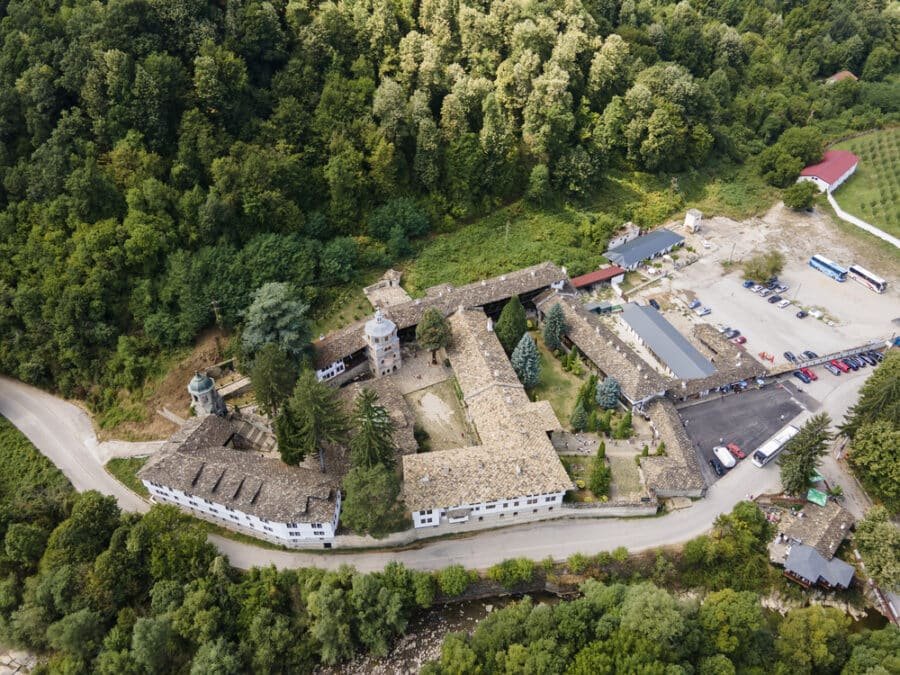
The Troyan Monastery is situated in the Lovech area, about 10 km from the town of Troyan, at the foot of the Stara Planina Mountains in the Troyan Balkans. It stands at about 400 meters above sea level and is surrounded by a beautiful natural landscape.
Considered the third biggest monastery in Bulgaria, the Troyan Monastery (Dormition/Assumption of the Most Holy Mother of God) was founded no later than the end of the 16th century and underwent major rebuilding and renovation between 1835 and 1855.
This impressive architectural complex features a central church, residential buildings, and two remarkable chapels. The main church, with its incredible frescoes, is one of the most exciting places in the complex.
In the nineteenth century, the monastery became a renowned literary and revolutionary center and functioned as an asylum for rebels under Ottoman Rule.
Troyan Monastery Highlights You Should Not Miss
One of the most remarkable objects treasured in the monastery is a miraculous icon. It represents Mother Mary and is known as Holy Mary with Three Hands (Troeruchitsa), depicted with a third hand in the iconography.
Besides that, do not miss the local plum spirit distilled by the monks on the premises.
How To Get To Troyan Monastery
A visit to Troyan Monastery can be a great day trip idea if you’re visiting Sofia or Plovdiv, either by bus or by car (about 2 hours from Sofia, 2.30 hours from Plovdiv). You can also join a guided tour of the Lovech area, which gives you free time to visit the monastery.
Where To Stay Near Troyan Monastery
It is possible to spend the night in one of the monastery rooms, though online booking is not available. You can call the monastery in advance to inquire at +359 69 522866.
Reasonably close to the monastery, Family Hotel and Restaurant Plamena in Oreshak enjoys a quiet location surrounded by a magnificent forest. Guests can enjoy comfortable rooms, free parking, and a delicious tavern with a cozy fireplace on the premises. Troyan is about 10 minutes by car from this property here.
Brands We Use And Trust
Best Monasteries Near Sofia For Easy Day Trips
The following monasteries in the Balkan Mountain Range are worth a visit. They are Dragalevski, Osenovlaskhi, and Klisura.
Dragalevski Monastery
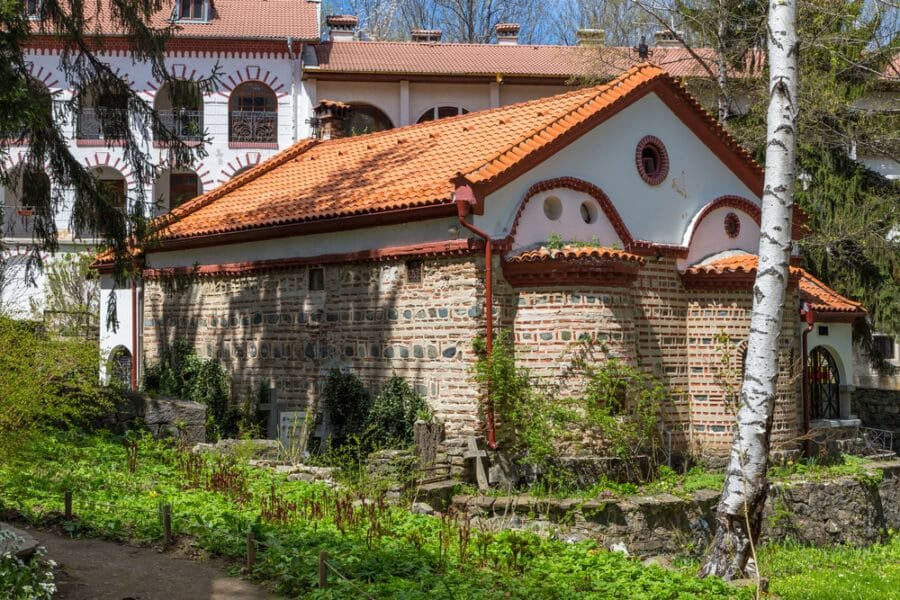
This monastery is located on Vitosha Mountain, on the outskirts of Bulgaria’s capital. It is easily reached by car, about 20 minutes from Sofia’s center.
The Monastery of the Holy Mother of God in Vitosha is an active monastery founded in the mid-14th century (commonly dated to 1345). It is inside the beautiful Vitosha Nature Park.
In 1382, the Ottoman Empire conquered Sofia, and the monastery was abandoned. It was then renovated back in the second half of the fifteenth century, its church restored and richly decorated with frescoes.
Dragalevtsi was another Bulgarian monastery active during the struggle for national liberation. It participated in secret revolutionary activities against the Ottomans.
The monastic complex includes a church as well as residential and farm buildings. The church features two layers of frescoes, while only fragments from several Biblical scenes have been preserved from the original narthex.
Where To Stay In The Area
Although you cannot stay on the premises, you can spend the night in the immediate area or even return to your hotel in Sofia.
Hotel Romantic is a valid alternative in the Vitosha District; it features suites and rooms, free public parking, a restaurant with a fireplace, and barbecue facilities. The city center is located a 10-minute drive away—more information here.
Osenovlashki Monastery – Seven Altars
Osenovlashki Monastery, also known as Sedemte Prestola (Seven Altars), is in the valley of the River Gabrovitsa, at the foot of the Izmeretz Mountain, about one hour from Sofia. The complex is easily accessible by car and train, following the Sofia-Mezdra route.
Although its exact foundation date is uncertain, the monastery is traditionally associated with medieval origins and was destroyed in 1737 during Ottoman rule. It was rebuilt in 1824, including a new residential building and a monastery school.
During the years of Bulgaria’s National Liberation from the Ottomans, Osenovlashki Monastery was often used as shelter by revolutionaries.
The spectacular complex includes a high stone wall with the main church traditionally dated to the 10th–11th century; the church has existed in its present form since 1815. The complex also features a church tower, a unique garden with flowers and blooming bushes, and a century-old sequoia. The monastery also has an important library with old Orthodox books.
The seven separate altars are unique to the church: four main altars forming a cross, two isolated altars, and a seventh one just opposite the entrance. Each altar represents a separate chapel and is dedicated to a Bulgarian saint.
Where To Stay In The Area
It is possible to stay at Osenovlashki Monastery; however, it is a good idea to book in advance as it is a popular area for locals to spend the weekend (the number is 087 9995035 in Bulgaria or +359 87 9995035 from abroad).
Guest House Bovada is another place to stay in the area. It offers a shared kitchen, a sun terrace, and a barbecue. All rooms have a patio with a garden view. The property is 39 km from Sofia Airport and offers a paid airport shuttle service. Read more here.
Klisura Monastery
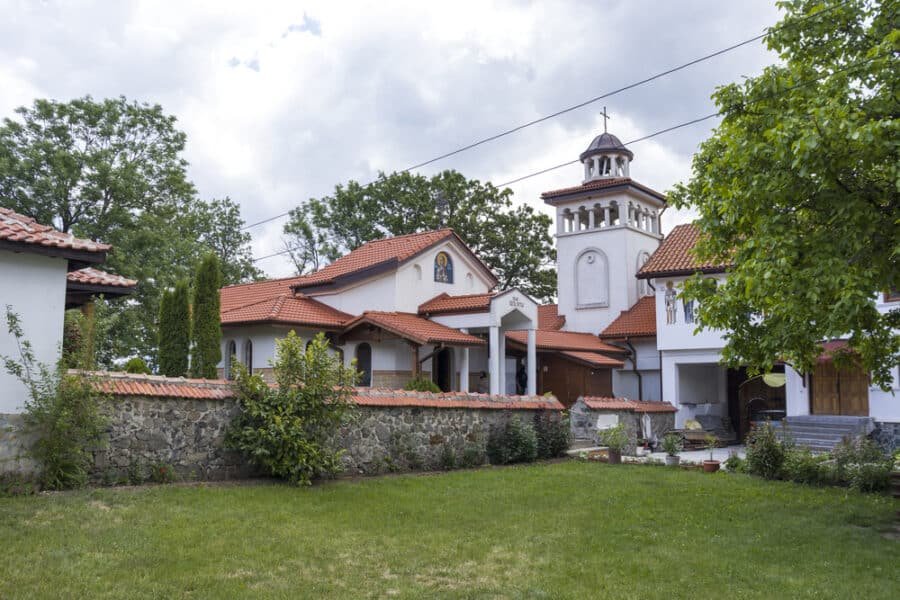
Dedicated to Saint Cyril and Saint Methodius, the Klisura Monastery is located at the foot of Todorini Kukli Peak in the valley of the River Vreshtitsa. The monastery complex dates back to 1240 and is about 85–95 km from Sofia.
The easiest way to reach the Klisura Monastery is by car, taking the road to Montana. The road is modern and well-signed.
The monastery was known as Vreshetski when it was founded. As with many other monasteries in the country, the complex was completely devastated by the Ottomans in the fifteenth century and remained abandoned for several years.
Brought back to life thanks to generous donations from locals, the building suffered a tragedy during the celebration day of Saints Cyril and Methodius, when the cloister was burnt to ashes and monks and pilgrims were slaughtered by the Turkish.
The monastery underwent a complete renovation in 1869, when it adopted its present Renaissance style. Today, the monastery includes two churches, a residential building, and farming premises.
The monastery houses precious objects, including old icons, books, and valuable relics of saints.
Where To Stay In The Area
The monastery offers accommodation in 80 beds or two apartments at affordable rates. There is also a restaurant on the premises serving traditional Bulgarian dishes made with products from the monks’ farm. (the number is 088 6560612 in Bulgaria or +359 88 6560612 from abroad).
Guest House Bankya offers affordable accommodation nearby and has excellent reviews. It has a gorgeous rose garden, barbecue facilities, and a shared kitchen. Breakfast is served daily, while lunch and dinner can be arranged upon request and for a surcharge. Sofia is only 16 km from the property. Read more here.
More Monasteries In Bulgaria Worth Adding To Your Route
Since there are so many monastic complexes to visit in the country, we have chosen the most remarkable ones and included them in the following section; take a look.
Sokolski Monastery
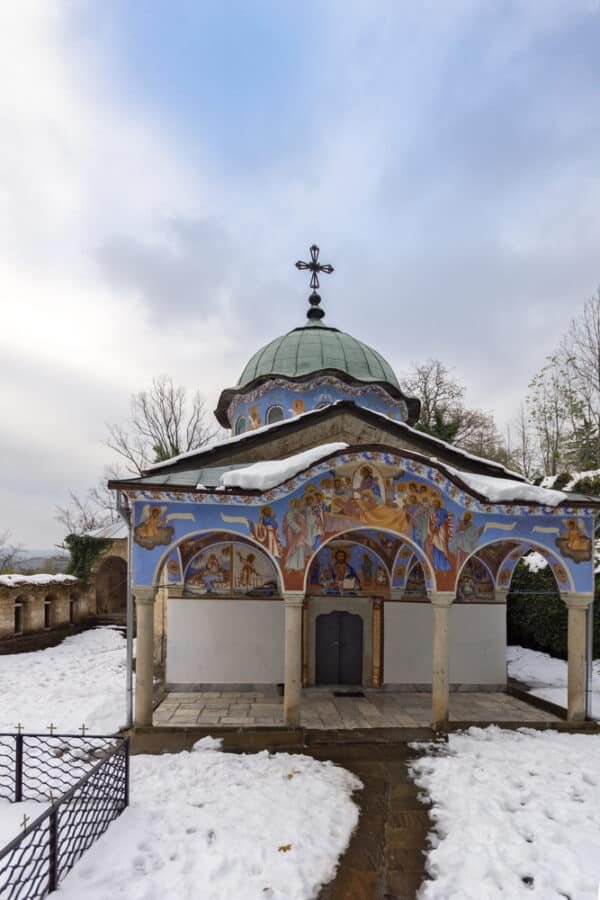
This beautiful complex is located near the town of Gabrovo on the northern slopes of the Balkan Mountains. The monastery can be reached by public bus or car.
Sokolski Monastery, dedicated to the Assumption of the Virgin Mary, is 220 km from Sofia. It is located in a tranquil area surrounded by high peaks and lush forests.
It was founded in 1833 and has a rich history. It was also an important refuge for revolutionaries against Ottoman rule. Later, during the Russian-Turkish War of Liberation, it functioned as a military hospital. Today, it is possible to visit the small collection on the premises that exhibits relics from the period.
Inside the complex, a beautiful courtyard is adorned with flowers, and pilgrims stop at a delicate fountain with intricate architecture to drink the refreshing water, gorging from eight different spouts.
In the different buildings, beautiful, simple frescoes in bright shades, uncommon in the traditional Byzantine school of painting, can be admired.
Where To Stay In The Area
The monastery offers rooms with private or shared bathrooms. Alternatively, you can check out the convenient Guest House Mikaela premises, which features a shared lounge, garden, barbecue facilities, and a terrace in Gabrovo. More information is here.
Preobrazhenski Monastery – Transfiguration Monastery
Also known as the Monastery of the Transfiguration, this complex is located in the Veliko Tarnovo area, the older Bulgarian capital.
Often described as one of Bulgaria’s largest monasteries, it is one of the most notable monastic sites in the Veliko Tarnovo area. It stands at the foot of a cliff with sweeping views of the surrounding region.
The monastery is traditionally associated with medieval origins (often dated to the Second Bulgarian Empire), while much of the present complex was rebuilt in the 19th century. The building stands around a rectangular paved court with old, picturesque pergolas. In the complex, there is also a belfry with a clock.
In 1991, the monastery was struck by a rock that fell from a hill, destroying a few cells.
Where To Stay In Veliko Tarnovo
Hotel Alegro is ideally located on a quiet street in the central part of Veliko Tarnovo. It offers original architecture, modern suites, and a restaurant garden. More information is here.
Basarbovo Monastery
In the Rusenski Lom River Valley, near the village of Basarbovo and about 10 km from Ruse, lies Basarbovo Monastery. This is the only rock monastery in Bulgaria that is still active and functioning.
To reach the premises, one must follow a green path, pass a well, and then hike up about 48 steps to reach a platform guarding the niche of Saint Dimitri Basarbovski. Once here, one can see a rocky chapel with a full-sized icon of the saint.
The monastery is associated with the Second Bulgarian Empire, with the earliest written mention in an Ottoman tax register from 1431; inside the premises, a former bone vault now houses a museum.
Where To Stay In Ruse
Grand Hotel Riga is located on the shores of the Danube River, just meters from the Ruse Main Square. It offers guests a summer garden, breakfast, and free parking. Read more about the accommodation here.
Glozhene Monastery
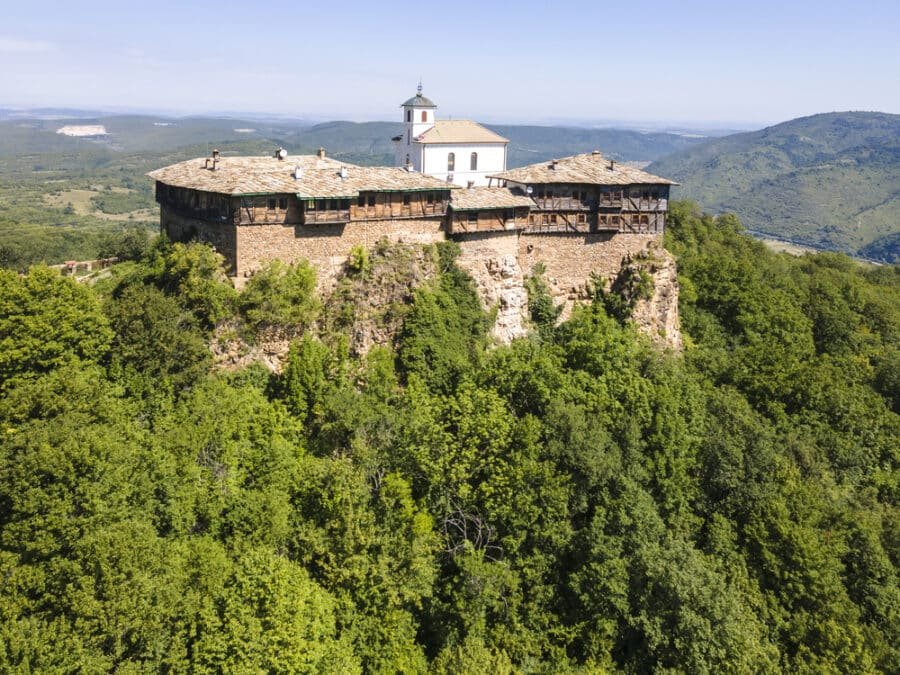
Enjoying a marvelous location with impressive views, Glozhene Monastery stands atop a rock on the western side of the Balkan Mountains, near the village of Glozhene.
Locals told me the monastery was founded in the 13th century by a prince, and it’s still surrounded by legends and local stories.
According to popular belief, the monastery’s icon of Saint George the Victorious disappeared from the holy cloister repeatedly. The monks later found the icon on a hill near the village where the current monastery stands today. In fact, the monks understood that the mysterious disappearance of the icon meant that God wished the monastery to be constructed on the hill.
The monastic structures include a church and a two-story residential building in the shape of a castle. The former church in the same spot was destroyed by an earthquake in 1913 and rebuilt in 1931.
Where To Stay In The Area
The monastery offers minimal accommodation (about 20 guests accepted); however, there are good places to stay nearby.
Holiday Park Mirovets in Malŭk Izvor features convenient accommodation, a restaurant, a shared lounge, a garden, and a children’s playground. Read more about the accommodation here.
Rozhen Monastery
Located in the Melnik area, Rozhen Monastery is a perfect place to combine a visit with a beautiful hiking path. Although it is possible to drive there, you can also access the monastery by walking a magnificent eco-trail.
The building is in the heart of the Pirin region, surrounded by the spectacular landscapes of Melnik and its pyramids.
Dedicated to the Nativity of the Theotokos (Virgin Mary), Rozhen Monastery is first documented in 1551; its church was built before the 15th century and painted in 1597, and the complex was later rebuilt and restored after major fire damage in the 17th century.
During the visit, don’t miss the imposing Church of the Nativity of the Virgin, which features ancient murals with Biblical scenes and unique stained-glass windows.
Where To Stay In The Area
Although the monastery does not offer accommodation, it is minutes from Melnik, a popular tourist destination with plenty of hotels and studios to rent.
Otherwise, in the heart of Rozhen Village, Family Hotel Dinchova Kushta is an excellent place to stay when visiting the monastery, which is only 2 km away. Surrounded by a peaceful green area, this rustic hotel, restaurant, and winery offer comfortable rooms, homemade Bulgarian dishes, and special wine-tasting sessions. Read more about the hotel here.
Aladzha Monastery
About 15 km from the city of Varna, near the beautiful Black Sea coast, this cave monastery is a famous site on the Black Sea Coast, about 2 km from the Golden Sands resort. The premises date back to medieval times.
Several ghost stories and mystic legends are mysterious, enchanting, and part of the atmosphere in Aladzha. Carved and arranged over two levels, connected by an external staircase, the complex includes a temple, monastic cells, a refectory, a kitchen, and a cemetery church.
Where To Stay In The Area
Hotel Amfora is located about 6 km from the monastery, in the resort area of Varna, and 5.5 km from the city center; it offers rooms with balconies and sea views. The hotel features an outdoor swimming pool, a restaurant, and free parking—more information here.
The Ivanovo Monastery
The Rock-hewn Churches of Ivanovo, set in limestone cliffs near Ruse, are famous for their remarkable 13th–14th-century frescoes. Monks began inhabiting the caves in the 1220s, and the complex flourished with major patronage during the Second Bulgarian Empire, including during the reign of Tsar Ivan Alexander.
The Ivanovo Monastery stands as a testament to the ingenuity and faith of medieval Bulgaria, offering insights into the lives of hermit monks and the Byzantine influence on Bulgarian ecclesiastical art.
Dryanovo Monastery
Dryanovo Monastery “St. Archangel Michael,” situated in the extraordinarily beautiful area near Dryanovo, has a tumultuous history marked by resilience and rebirth. Initially built in the 12th century, it was destroyed and rebuilt several times, with the current structure dating back to the 19th century.
This monastery played a significant role in the Bulgarian Revival period and the fight against Ottoman rule. It is not just a place of spiritual solace but also a symbol of Bulgarian resistance and pride.
Move This Adventure To Your Inbox & Get An Instant Freebie

No spam. Unsubscribe at any time.
Bulgarian Monasteries FAQs
Which Bulgarian monastery is best to visit if you only have one day?
Rila Monastery is the most famous and widely visited choice, set in the Rila Mountains and listed as a UNESCO World Heritage site.
What are the top three monasteries in Bulgaria?
Rila Monastery (the largest and most famous), Bachkovo Monastery (a major southern monastery near Plovdiv), and Troyan Monastery (the third-largest in the Balkan Mountains) are commonly considered the “top three” for first-time visitors.
Which monasteries in Bulgaria are UNESCO World Heritage sites?
Rila Monastery was inscribed in 1983, and the Rock-hewn Churches of Ivanovo were inscribed in 1979.
Is Basarbovo Monastery really the only active rock monastery in Bulgaria?
Basarbovo is widely cited as the only active cave (rock) monastery in Bulgaria’s modern history, located near Ruse in the Rusenski Lom River Valley.
When is the earliest written mention of Basarbovo Monastery?
The earliest written mention is commonly dated to an Ottoman tax register from 1431, while the site is also associated with the period of the Second Bulgarian Empire.
What is the “Seven Altars” monastery near Sofia actually called?
It is Osenovlashki Monastery, popularly known as Sedemte Prestola (Seven Altars).
Why is it called the Seven Altars monastery?
The church’s layout features seven separate altars (thrones), a design considered unique in Bulgaria.
What is the famous icon at Troyan Monastery?
Troyan Monastery is known for the Troeruchitsa (Holy Mary with Three Hands), an iconographic tradition showing the Virgin with a third hand.
Can you stay overnight in Bulgarian monasteries?
Some monasteries offer accommodation (including Rila and Bachkovo), typically in monastery-run rooms booked directly rather than via standard hotel platforms.
What is the correct name for the park around Dragalevtsi Monastery?
Dragalevtsi Monastery is located within the Vitosha Nature Park (not a national park).
Where are the Rock-hewn Churches of Ivanovo located?
They are near the village of Ivanovo, close to Ruse, carved into cliffs above the Rusenski Lom River, and are known for 13th–14th century frescoes.