Hello there! I’m an Australian living in Croatia, married to a local with two energetic boys, ages 13 and 8, and diving deep into the vibrant world of the Croatian language.
As a fellow language learner, let me take you on a journey through the linguistic landscape of this beautiful country, with its rich cultural heritage, which I now call home.
Croatian (Hrvatski) is the official language of Croatia and is written in the Latin alphabet. English is widely spoken, especially in cities and tourist areas, making travel easy. Croatian is closely related to Serbian and Bosnian, but it has its own standard form and dialects.
| Topic | Fact |
|---|---|
| Official language | Croatian (Hrvatski) |
| Writing system | Latin alphabet |
| Number of letters | 30 |
| Main dialects | Čakavian, Kajkavian, Štokavian |
| Script variants nearby | Latin & Cyrillic (regionally) |
| EU official language | Yes (since 2013) |
| ISO language code | hr |
| English proficiency | Very High (EF EPI) |
So, What Language Do They Speak In Croatia?
There are a little under 4 million people in Croatia, and the official language of Croatia is “Croatian,” which is known as Hrvatski in Croatian.
It is one of the South Slavic languages and is written in the Latin alphabet.
There’s a high degree of mutual intelligibility between Croatian and Serbian. Croatian is closely related to standard Bosnian, Serbian, and Montenegrin, but it has its own distinct characteristics and dialects. The three major dialects of Croatian are Čakavian, Kajkavian, and Štokavian, with Štokavian serving as the basis for the standard Croatian language.
But there are many more regional dialects – everyone I ask tells me a different number. But it is a lot, which is not surprising given the many other regions in Croatia.
Do They Speak English In Croatia?
English is widely spoken, especially in tourist parts of Croatia, major cities like Zagreb, Split, and Dubrovnik, and along the stunning Adriatic coast. Croats, particularly the younger crowd and those in the hospitality industry, have a pretty good grasp of English, thanks to the country’s strong emphasis on language education and the booming tourism sector.
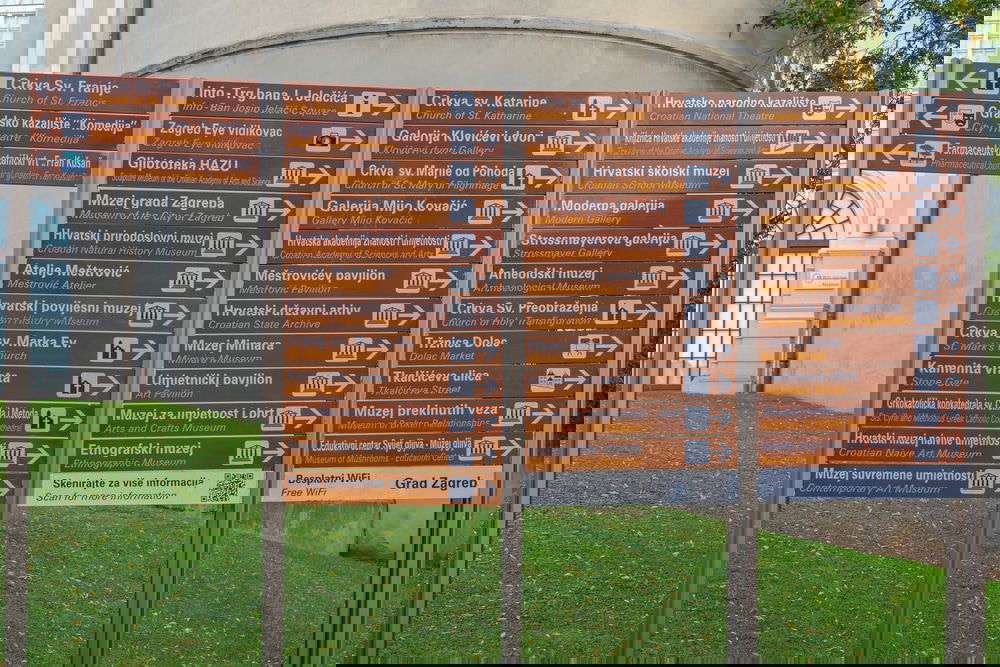
While standard Croatian is the official language, you’ll find that menus, signs, and information in popular tourist spots often come in English, too.
Skip Ahead To My Advice Here!
Discover The History Of The Language Spoken In Croatia
Alright, let’s jazz up the history of the national language in Croatia a bit and throw in some cool facts!
So, Croatia’s not just about those jaw-dropping coastlines. Croatia, with cities like Dubrovnik and Split, situated along the Adriatic coast, is also home to a language as fascinating as its scenery. Croatian, which belongs to the South Slavic language group, has much in common with Serbian, Bosnian, and Montenegrin. But it’s got its own special Croatian twist.
Here’s a fun historical tidbit: Croatian replaced Latin as the official parliamentary language on October 23, 1847. Croatian began to be formally used in parliamentary proceedings thereafter.
Now, the superhero behind this language revolution was Ivan Kukuljević Sakcinski, a history buff and writer from Varaždin. This guy made a bold move on May 2, 1843, by giving the first speech in Croatian in the Croatian Parliament.
Talk about a mic-drop moment for such a relatively small country!
He was all about making Croatian the go-to language in schools and offices, and he knew how important it was to keep Croatian from being overshadowed by other languages. Before this, Latin was the go-to language in parliament, but Kukuljević Sakcinski was like, “Nope, it’s our time now!”
So, next time you’re chatting in Croatian, give a little nod to Kukuljević Sakcinski.
National Dialects & Regional Variations Of The Official Language
You know, Croatia may not be the biggest country on the map, but let me tell you, the variety in dialects here is something else!
We’ve got Čakavian along the coast, where the language almost dances with the rhythm of the waves. Then there’s Kajkavian up in the northwest – it’s got this old-world charm to it, like a song from days gone by. And the big one, Štokavian is the basis of standard Croatian and is taught in schools; it is also common in Split, alongside strong local Čakavian influences.
The funny thing is, even living here and picking up Croatian bit by bit, these dialects can throw me for a loop.
Like, our business partners from Zagorje, right? And when he chats with his family, it’s like they’re speaking another language compared to what I am used to on the Dalmatian Coast. I’m there scratching my head, but luckily, my husband’s got it down, so he fills me in later. It’s all part of the adventure, I guess – keeps life here interesting!
Information on the Croatian Language In Daily Life
So, here’s the deal with Croatian and languages in general in this lovely country. First off, Croats are pretty savvy with languages. Besides Croatian, most people here in countries such as Montenegro and Serbia juggle more than one language.
It’s like linguistic gymnastics! Balancing between intelligible languages.
Now, about English – it’s a big deal here. Kids start learning English as a second language in school from around the 4th grade, though the exact starting year can vary by school and curriculum. For example, my kids’ school started in 1st grade.
Imagine that! And the foreign language learning doesn’t stop there. Later on, they pick up a third language. Talk about multi-lingual talents, right?
Here’s a fun fact that blew my mind: Croatia consistently ranks in the “Very High Proficiency” tier of the EF English Proficiency Index.
This is likely driven by younger generations. Recent EF English Proficiency Index results place Croatia well above the global average.
That’s pretty impressive! It means not only that they start young, but also that they get really good at learning basic phrases.
From personal experience, it’s fascinating to see my own boys, aged 11 and 6, navigating through the different languages. They speak English and Croatian and even dabble in a third language, German, at school. My oldest also learns parts of new languages on a language app. His latest favorite is Greek.
It’s like they’re building their own mini Babel tower, and I’m just trying to keep up! The good news is that when we go to Germany, my kid can help us read.
So, next time you’re wondering about languages in Croatia, remember – these folks are like language ninjas, and their English proficiency? Top-notch!
Brands We Use And Trust
Minority Languages – What Other Language Is Spoken In Croatia?
Alright, let’s chat about the other languages you’ll hear in Croatia – it’s not just Croatian and English, you know!
So, besides Croatian, there’s a whole mix of languages spoken by different folks here as minority languages. Think of it like a linguistic buffet. You’ve got
- Serbian
- Czech
- Italian
- German
- Hungarian
- Slovak, and even
- Romani is another unique language to discover in Croatia.
It’s a pretty cool mix.
And here’s the scoop: Italian and German are like the popular kids in the language school, but English? It’s the superstar, as I already told you!
Everyone’s learning it or already chatting away. It’s like the universal language glue holding all these different tongues together. Croatia has incredible language diversity, and it’s pretty awesome to experience!
Popular Croatian Language Phrases Travelers Might Need

Whether you’re ordering a coffee or saying hello, knowing a few Croatian phrases goes a long way. “Dobar dan” (Good day) and “Hvala” (Thank you) are your best friends. Trust me, the locals appreciate the effort!
If you want to go further, below are some of the things you can learn to say. Click here for a massive list of Croatian travel phrases that Mateja (my old Croatian language teacher) gave me to know.
Good Morning/ Good Evening / Good Night
Dobro jutro (DOH-broh YOO-troh)
Dobra večer(DOH-brah VEH-chehr)
Laku noć (LAH-koo nohtch)
How are you?
Kako ste? That’s one of the basic Croatian words to know. (KAH-koh steh?) Formal
Kako si? (KAH-koh see?) Informal
Fine, thanks.
Dobro, hvala. (DOH-broh, HVAH-lah.) – Useful basic phrases in Croatian
And you?
Vi? (Vee?) Formal
Ti? (Tee?) Informal
Please / Yes, please
Molim (MOH-leem)
Da, molim. (DAH, MOH-leem)
Thank you / Thank you very much
Hvala (HVAH-lah)
Puno hvala (Puh-noh HVAH-lah.)
Croatians Language History
Alright, let’s jazz up the history of the Croatian language a bit!
Way back before Croatian was even a thing, Latin was the cool kid on the block, influencing future literary languages. But then, in the 6th and 7th centuries, the Slavs re-entered the empire and brought their regional Slavic dialects with them.
Fast forward to today, and what we’ve got is this excellent language called Hrvatski, or Croatian as we know it. It’s got these three unique dialects I mentioned earlier – Čakavian, Kajkavian, and Štokavian.
Is Croatian The Same Language As Serbian
Alright, let’s break down this Croatian vs. Serbian language thing in a way that’s easy to digest.
First up, they are considered separate standard languages, and while they share the same linguistic base, they differ in standard usage and script preferences.
You know how twins can be super similar but still have their quirks? That’s kind of like Croatian and Serbian speakers. Sure, they sound a lot alike and share a ton of words and grammar. But here’s the kicker: Croatian is written in the Roman alphabet, you know, the one we use in English.
Meanwhile, Serbian officially uses both Cyrillic and Latin alphabets, with Cyrillic being constitutionally preferred in Serbia.
Linguists often say that Croatian, Serbian, and Bosnian are like three flavors of the same language. But the politics around it can be a bit touchy.
In my experience, when Croatian people, Serbs, and Bosnians chat, they can understand each other.
So, in a nutshell, Croatian and Serbian are like close cousins in the language world. Similar, but with their distinctions.
Where Else Do They Speak Croatian
You might think Croatian is only spoken in Croatia, right? But hold on to your hats because this language gets around!
First up, in Bosnia and Herzegovina, Croatian is one of three official languages, alongside Bosnian and Serbian. Then, over in Austria’s Burgenland region, about 50,000 folks speak Burgenland Croatian. It’s an excellent mix of the local Chakavian dialect with a bit of a twist from other Croatian dialects in the area.
But wait, there’s more! In Italy’s Molise region, about 2,000 people are familiar with Molise Croatian. This Shtokavian dialect traces back to the history of Croatian Dalmatian refugees from the 15th and 16th centuries.
And guess what? In Serbia, especially in the Vojvodina region, Croatian is also quite important, thanks to the large Croatian community there.
To top it off, Croatian has been one of the official languages of the European Union. Since 2013, Croatian has also been recognized in Romania, in places like Carașova and Lupac, alongside Romanian.
So, nope, Croatian isn’t just a Croatia thing – it’s a bit of a globetrotter!
Croatian Alphabet Facts
Let’s make the Croatian alphabet a bit more fun and easy to get, shall we?
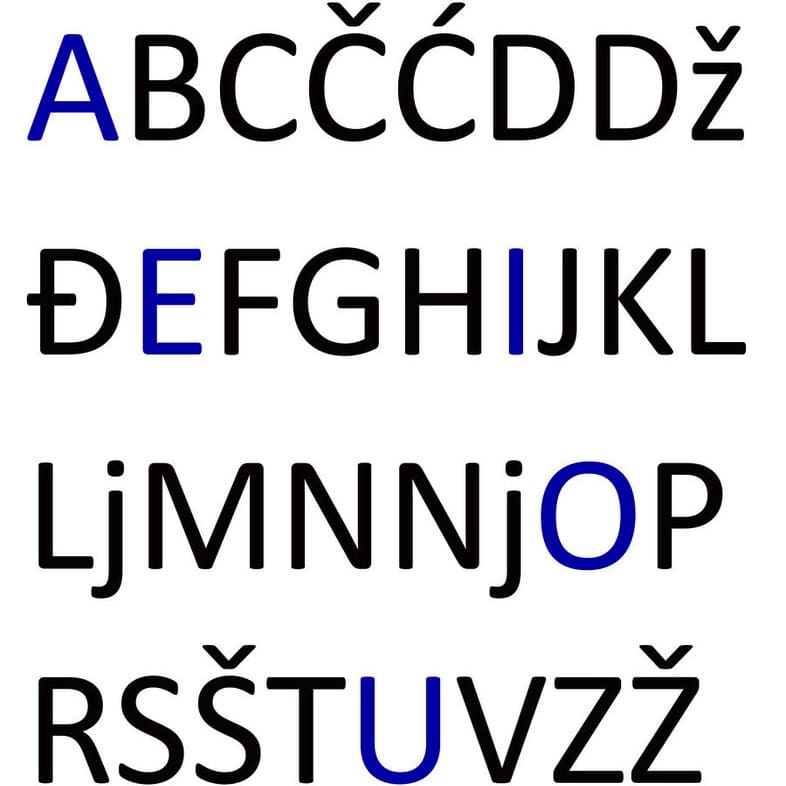
So, Croatian uses the Latin alphabet, but with a twist – it’s got 30 letters! Imagine that, four more than the usual English set. These extra letters are like the secret sauce that gives Croatia its unique flavor.
Eight letters in Croatian are kind of like the cool kids in class – “Č,” “Ć,” “Dž,” “Đ,” “Lj,” “Nj,” “Š,” and “Ž.” They’re special because you won’t find them in the standard English alphabet.
But wait, there’s more! Croatian says ‘no thanks’ to ‘Q,’ ‘W,’ ‘X,’ and ‘Y.’ You might see them hanging around in foreign names or brands, but they’re not part of the regular gang.
And here’s a quirky thing: Croatian has letters that are like a dynamic duo – digraphs! “Dž” is like the ‘j’ in ‘jam,’ “Lj” is a unique sound, kind of like the ‘ll’ in ‘million,’ and “Nj” is like the ‘ny’ in ‘canyon.’ These aren’t just two letters chilling together; they’re considered one letter in Croatian.
So, in a nutshell, the Croatian alphabet is like the usual one but with some cool extras and a few no-shows. It’s what makes Croatian sound so distinct and awesome!
Basic Croatian Words
Native speakers love it when you try to say a few words in Croatian.
It is generally considered challenging for adult learners, particularly due to grammar and cases.
That said, here are some pretty easy ones to learn to get you started, and here are a few more if you want to keep going.
Hello
Bok (bohk)
Good Morning/ Good Evening / Good Night
Dobro jutro (DOH-broh YOO-troh)
Dobra večer(DOH-brah VEH-chehr)
Laku noć (LAH-koo nohtch)
How are you?
Kako ste? (KAH-koh steh?) Formal
Kako si? (KAH-koh see?) Informal
Fine, thanks.
Dobro, hvala. (DOH-broh, HVAH-lah.)
And you?
Vi? (Vee?) Formal
Ti? (Tee?) Informal
Please / Yes, please
Molim (MOH-leem)
Da, molim. (DAH, MOH-leem)
Thank you / Thank you very much
Hvala (HVAH-lah)
Puno hvala (Puh-noh HVAH-lah.)
You’re welcome
Nema na čemu (NEH-mah nah cheh-moo)
Goodbye
Doviđenja (Daw-vee-je-nya)
Bye
Bok (bohk)
FAQs About The Croatian Language
Is English enough for traveling in Croatia?
Yes, English is generally enough for traveling in Croatia. In tourist areas, cities, hotels, restaurants, and transport hubs, English is widely spoken. Most travelers can comfortably navigate accommodation, dining, tours, and transportation using English alone.
Do Croatians expect tourists to speak Croatian?
No, Croatians do not expect tourists to speak Croatian. However, making a small effort with basic phrases like ‘hello’ or ‘thank you’ is appreciated. Locals are usually happy to switch to English, especially when they hear a foreign accent.
Can I get by with English outside tourist areas?
You can usually get by with English outside tourist areas, but proficiency may be more limited in rural regions and small inland towns. Younger people are more likely to speak English, while older generations may not. Basic gestures and a few Croatian words can be helpful in these situations.
Are road signs in Croatia in English?
Road signs in Croatia are primarily in Croatian, but they use international symbols and the Latin alphabet, making them easy to follow. Major tourist destinations, highways, and border crossings often use internationally recognizable place names rather than English translations.
Is it hard to learn Croatian?
In my experience, yes. The grammatical gender, different dialects, and word order are all vastly different from my mother language. That and I am just a really slow learner, I have come to realize.
Is Croatian a phonetic language?
Yes, Croatian is phonetic mainly. Words are pronounced the way they are written, with consistent pronunciation rules. Once you learn how each letter sounds, reading and pronouncing Croatian words becomes much easier.
Is Croatian closer to Serbian or Slovenian?
Croatian is much closer to Serbian than to Slovenian. Croatian and Serbian are both South Slavic languages and are largely mutually intelligible. Slovenian differs more in vocabulary, grammar, and pronunciation.
Which Croatian dialect will I hear in Dubrovnik / Zagreb / Split?
In Dubrovnik and along much of the Dalmatian coast, you will hear a mix of standard Croatian and local Čakavian influences. In Zagreb and northern Croatia, Kajkavian is commonly spoken in informal settings. In Split, standard Croatian is widely used, but local Dalmatian speech with strong Čakavian features is very noticeable in everyday conversation.
What are some basic greetings in Croatian?
Greetings in Croatian include Dobar dan (Good day), Dobro jutro (Good morning), Dobra večer (Good evening), and Hvala (Thank you).
Is learning Croatian phrases difficult?
Learning Croatian can be challenging for non-native speakers, but making an effort to use it is appreciated by locals.
Where can I find resources to learn Croatian?
You can find helpful resources on YouTube, including videos teaching Croatian phrases. Watching Serbian or Croatian films with English subtitles can also assist in learning.
What are some phrases for shopping and dealing with money?
Phrases for shopping in Croatian include Koliko košta? (How much does it cost?) And Imate li to u drugoj boji? (Do you have this in a different color?) For dealing with money, Molim vas, račun (Please, the bill) can be used when asking for the bill.
How can I navigate transportation in Croatia?
When using public transportation, you can say Koliko košta karta do…? (How much is a ticket to…?) to ask about the ticket price. To get off at a specific stop, say Ovdje moram izaći (I need to get off here).
What phrases can I use for directions?
For directions, you can use Gdje je…? (Where is…?) or Kako doći do…? (How do I get to…?).
What are some useful phrases for eating and drinking?
When dining, you can say Molim jelovnik (Can I have the menu, please?). To order, use Molim followed by the item you want, such as Molim jedan sendvič.
What are some phrases for sightseeing and attractions?
When sightseeing, you can ask Možete li mi preporučiti neka popularna mjesta? (Can you recommend some popular places?) or say Predivno je (It’s beautiful).
What should I know about accommodations?
Useful phrases include Imate li slobodne sobe? (Do you have any available rooms?) and Molim vas, mogu li dobiti Wi-Fi lozinku? (Can I have the Wi-Fi password?)
What is the Croatian language code?
The Croatian language code is hr (ISO 639-1).
How can I handle difficult situations or emergencies?
In emergencies, useful phrases include Pomoć! (Help!), Hitna pomoć (Emergency medical help), and Gdje je najbliža policijska postaja? (Where is the nearest police station?).
Move This Adventure To Your Inbox & Get An Instant Freebie
No spam. Unsubscribe at any time.
Learning Croatian: Challenges And Resources
As someone who’s still grappling with the nuances of Croatian, I can say it’s a challenging yet rewarding journey. There are resources for learners like me, such as the University of Zagreb’s language courses, many, many online platforms, and one like this that offers free online lessons and local language cafes in Zagreb, all making learning Croatian accessible and fun.
My Final Word On Languages In Croatia
So now that we’ve established that Croatian is the official language of several languages spoken in the country.
Trust me, understanding even just a little Croatian is key to experiencing Croatian culture and heritage if you live here. I have tried very hard, but as a native English speaker who never learned a language before the age of 36, it has been challenging.
If you are on vacation, you can speak other languages and have no problem finding someone who speaks your language across all sections of the tourism industry. Croatians know it is not the most widely spoken language, so they’ll happily try to talk to you in your language while you’re on your trip.
- What To Pack For Croatia
- Ultimate Guide To Accommodation In Croatia
- Come To Zagreb For A Dental Implant Vacation
- Best Beaches In Croatia
- Croatia Airport Transfers
- Weird, Interesting & Unique Things To Do In Croatia
- Explore Croatia In Winter
- Croatian Wine You Can’t-Miss
- Croatia Road Trip Itinerary
- Game Of Thrones Locations & Tours In Croatia
- Best Day Trips From Dubrovnik
- Places, Cities, And Towns In Croatia To Explore
- Car-Free Islands In Croatia
- What You Need To Know For Planning A Trip To Croatia
- Is Croatia Safe To Travel? Helpful Safety Tips
People really speak German there?