

Pula is Istria’s biggest city and one of Croatia’s best places to see Roman history without committing to a long multi-day itinerary. I’ve lived in Croatia for over a decade and keep coming back to Pula for the same reason: the sights are genuinely world-class, but they’re packed into a walkable Old Town you can cover in a single day if you plan it right.
This 24-hour itinerary focuses on the Arena, the main Old Town loop (arch, forum, temple, cathedral), and a sunset climb up to Kaštel, with practical, up-to-date details on entry costs and seasonal access.
Key facts for planning a one-day Pula itinerary:
| Stop | Typical Time Needed | Typical Cost | Notes |
|---|---|---|---|
| Pula Arena (Amphitheatre) | 45–90 minutes | Adults ~€10; children/students ~€5 | Seasonal hours; event days can change access; underground exhibition included |
| Market Hall | 30–60 minutes | Free to browse | Built 1902–1903; food options vary by day and season |
| Old Town Loop (Arch, Forum, Temple area) | 60–120 minutes | Free outdoors | Most sights are exterior-first; keep time for photos and short stops |
| Pula Cathedral | 15–30 minutes | Generally free | Access can be limited during services |
| Kaštel (Fortress) + Views | 30–75 minutes | Varies if entering the museum | Historical and Maritime Museum of Istria is inside; best near sunset |
Skip Ahead To My Advice Here!
How To Spend 1 Day In Pula
The place to be for tourists is Pula’s Old Town. While the rest of the town is pretty big, this historic core is very compact. You can easily walk around and through it in about an hour. It’s recommended to take your time, though, as there are a couple of landmarks that you’ll really want to visit.
Brands We Use And Trust
Morning: Pula Arena And The Market Hall
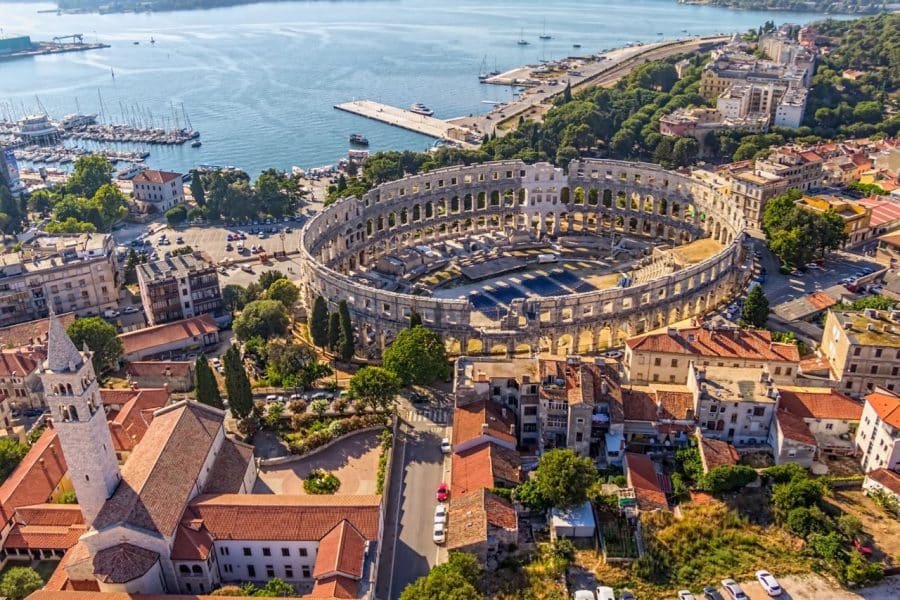
The main reason most visitors come to Pula is the Roman Arena. There are tens of Roman amphitheaters scattered across Europe and North Africa, but this is one of the best-preserved. It’s also the sixth-largest.
Pula’s Roman Amphitheater is arguably the best place in Croatia to feel like you’re in Ancient Rome. (Diocletian’s Palace in Split is a close second, though.)
The amphitheatre is open year-round, but opening hours vary by season, and access can change for events. Visitors are asked not to climb on the raised structures.
Built between 27 B.C. and A.D. 68 (under Augustus and Vespasian), this amphitheatre stayed in use for more than 300 years. At its peak, it could accommodate up to about 23,000 spectators.
Don’t miss the exhibition in the underground passages, which focuses on olive oil and wine production in ancient Istria, including an extensive amphora collection.
Fun Fact: the Pula Amphitheater also doubles as a venue for concerts, film festivals, sporting events, and performing arts.
You’ll probably spend a good chunk of the morning exploring the Amphitheater. Afterward, head directly south to the Market Hall when you’re done.
The Market Hall is much younger than the Amphitheater, built in 1902–1903 under Austro-Hungarian rule. This is arguably the best place in town for lunch.
The ground floor is where you’ll find the actual market, where everything from meats and fish to cheeses and olive oil is sold. It’s a great place to fill up a picnic basket. If you’d rather order a prepared meal, you can do so at the food court one floor up.
Entry is typically €10 for adults and €5 for children/students (under 5s usually free). Winter hours are roughly 09:00–17:00 (November–March), with extended hours in warmer months. Event days may affect access.
Afternoon: Old Town Walk With Roman Sights
Belly filled, it’s time to use that energy to walk around the Old Town. This area lies at the base of an ancient hill topped by a historic fortress. It’s an easy walk and impossible to get lost. Just walk around the hill, and you’ll hit all the highlights.
Starting at the Market Hall, it’s recommended to walk in a clockwise direction (to avoid backtracking toward the Amphitheater). On the way, you’ll come across several other Roman buildings as well as landmarks from other eras.
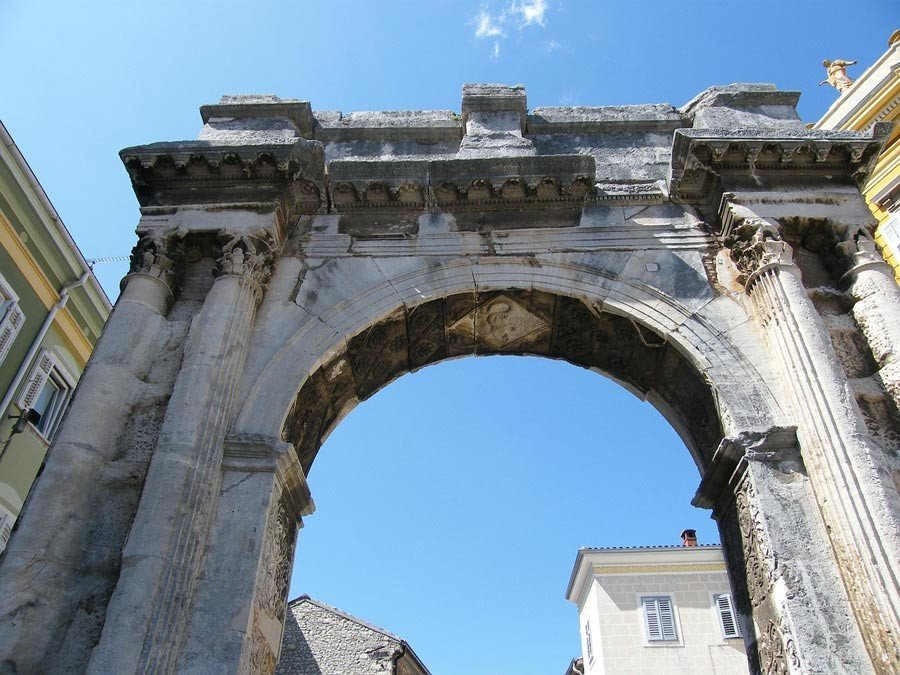
The first one you’ll see is the imposing Arch of Sergius, which marks the edge of the ancient Roman town. It’s an impressive triumphal arch dedicated to Lucius Sergius Lepidus, who fought with Augustus during the Roman civil wars after Julius Caesar’s death.
Continuing your walk through the arch, you’ll soon see the Basilica of St. Mary Formosa, a Byzantine-era religious structure. In front of the basilica lies the Roman Floor Mosaic, a brilliant example of what lies underneath the Old Town’s roads and buildings.
Next up is the Forum, the town’s main square during Roman times, and it still serves the same purpose today. Look around and notice the Temple of Augustus and the Town Hall. This is also where the visitor center is located.
Past the Forum, the Cathedral with its bell tower is the most important religious building in Pula. Its origins date to the 5th century, and it combines Romanesque and Venetian Baroque elements. Visiting is free, so make sure to pop in for a look around.
The Arch of the Sergii dates to roughly 29–27 B.C. and was paid for by Salvia Postuma Sergia to honour members of the Sergii family, including Lucius Sergius Lepidus.
Evening: Kaštel Views And Dinner In The Old Town

It’ll be late afternoon by now, so make your way up the hill to Fort Kaštel on one of the many trails from the streets below. Inside Fort Kašte,l you’ll find the Historical and Maritime Museum of Istria, and it’s also worth the climb for the fantastic views of the Old Town below.
You can walk along the ramparts for different vantage points. Needless to say, this is a superb spot for sunset-watching, with sweeping views over the Old Town and harbour.
Head back down for dinner in the Old Town. Restaurant Jupiter is a solid choice if you’re in the mood for pizza. For after-dinner drinks, head to Old City Bar.
FAQs
Is one day enough in Pula?
Yes, one full day is enough to cover the Arena, the main Old Town loop (Arch of the Sergii, Forum, Temple of Augustus area, Cathedral), and a sunset climb to Kaštel. You will not cover beaches, Brijuni, or Kamenjak in the same day without rushing.
How much is the Pula Arena ticket?
Daytime entry is typically €10 for adults and €5 for children/students, with children under 5 usually free. Prices can change, and special events have separate ticketing.
Is the Pula Arena open every day?
The Arena is open year-round, but opening hours vary by season and can change on event days. In the winter months, it is typically open for shorter hours, with extended hours in summer.
Can you climb the seats at the Pula Arena?
Visitors are asked not to climb on raised structures for safety and preservation. You can still walk the monument, access viewing areas, and visit the underground exhibition.
How long do you need at the Pula Arena?
Most visitors spend about 45–90 minutes, depending on crowds and how much time you spend in the underground exhibition and taking photos.
What is the underground exhibition in the Arena about?
The underground passages host an exhibition on olive oil and wine production in ancient Istria, featuring amphorae and related displays.
Is Pula Old Town walkable?
Yes. The Old Town core is compact and easy to do on foot, but expect uneven stone streets, stairs, and some uphill walking to reach Kaštel.
Is Pula Cathedral free to enter?
Entry is generally free, but access can be limited during services or special events.
What’s the best sunset viewpoint in Pula?
Kaštel is the classic sunset spot because it sits above the Old Town and harbour, giving you wide, elevated views.
What is Pula best known for?
Pula is best known for the Roman Arena (one of the best-preserved amphitheatres), plus a dense cluster of Roman-era sights in its Old Town.
Is Pula worth visiting if you’re based elsewhere in Istria?
Yes. Pula works well as a day trip because the headline sights are concentrated in the centre, making it easy to see the highlights without a long stay.
Does Pula feel industrial?
Parts of the wider city still reflect its shipbuilding and port heritage, but the visitor experience is centred on the historic core, where the main sights and dining are located.
Want to check out the city a little longer? Check out these great Pula accommodations!
You can also explore the life of James Joyce who lived there in 1904/5. Every June there is a Joyce festival which puts on a rich program and all for free.
Hi there! I am travelling to Istria for the first time in April over a weekend from Germany and not sure whether I should stay in Pula for 2 nights or Kamenjek. Any advice? :)
You should look up what pula means in Romanian and read the article again
Bahahahhaaaaaa